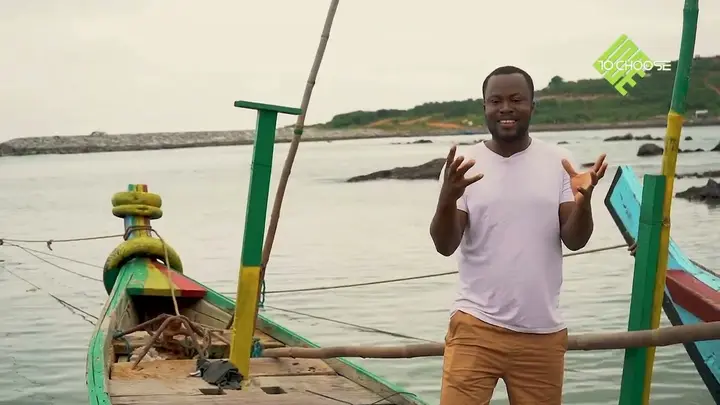
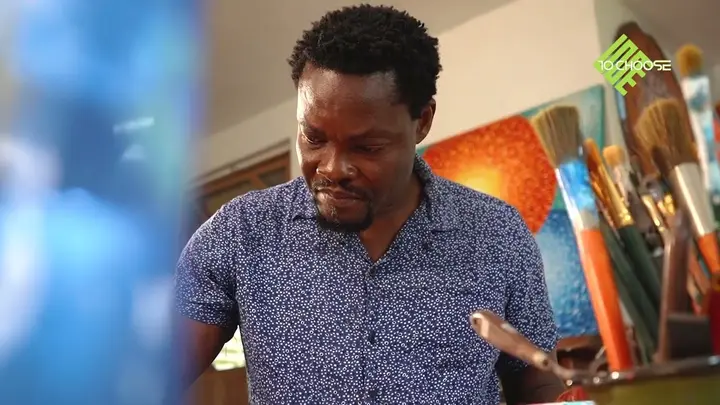
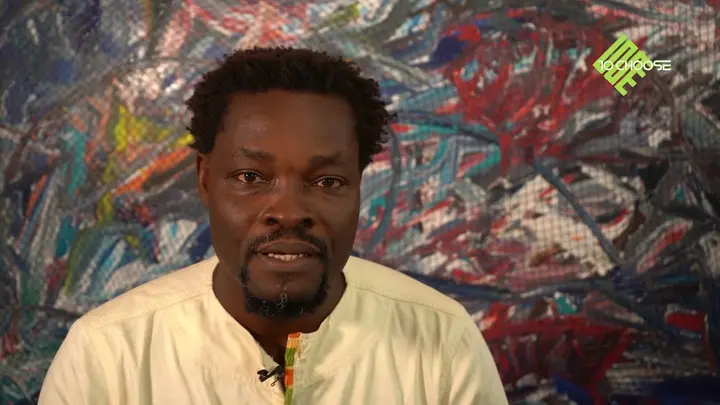
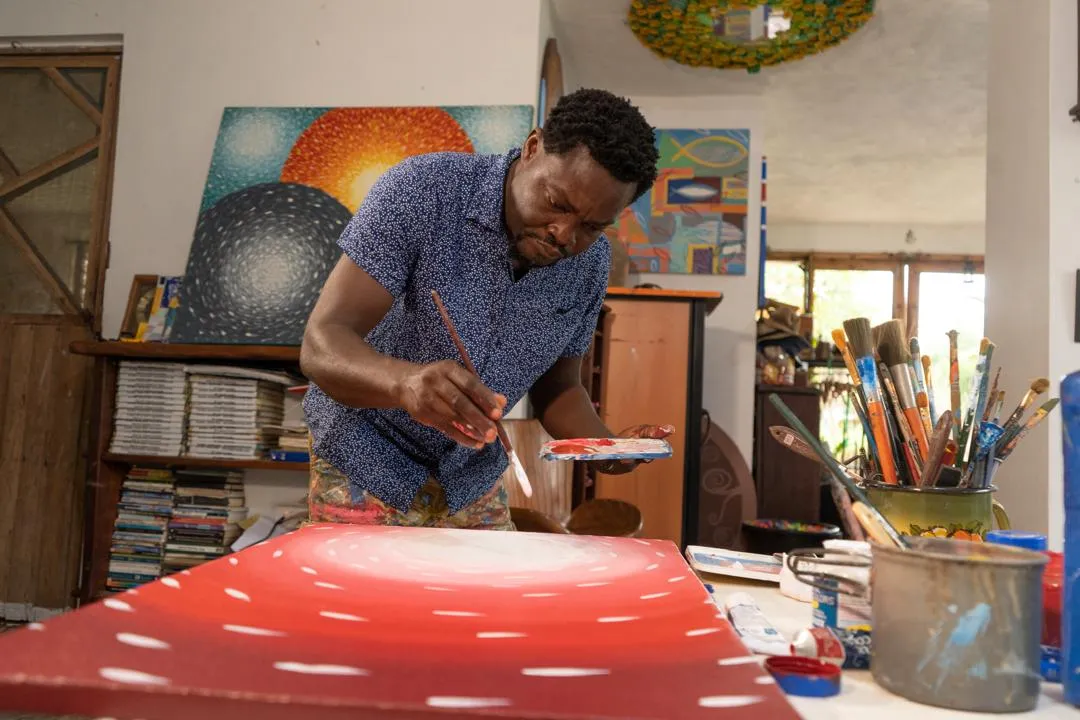
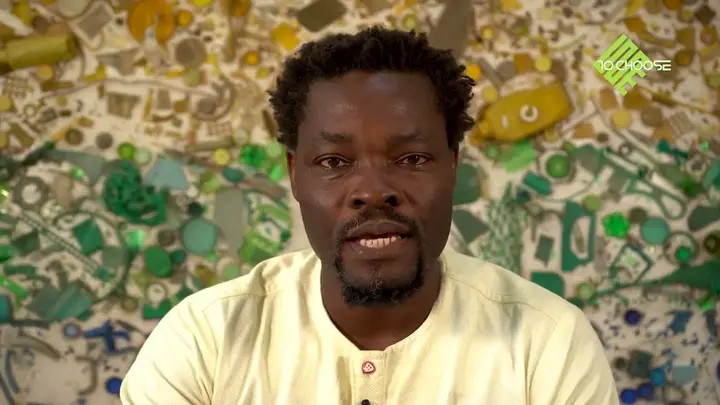
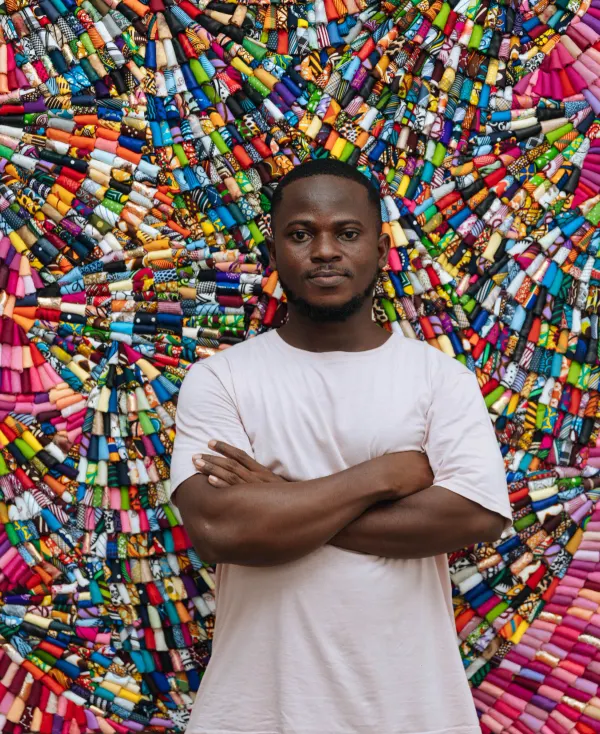
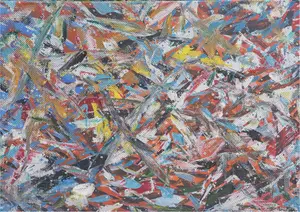
Kobina Nyarko has painted the sea off Ghana for more than twenty years. Michelle “Mishvania” Beattie builds sculptures from the plastic it washes up near Cape Town. Take a breath and go down.
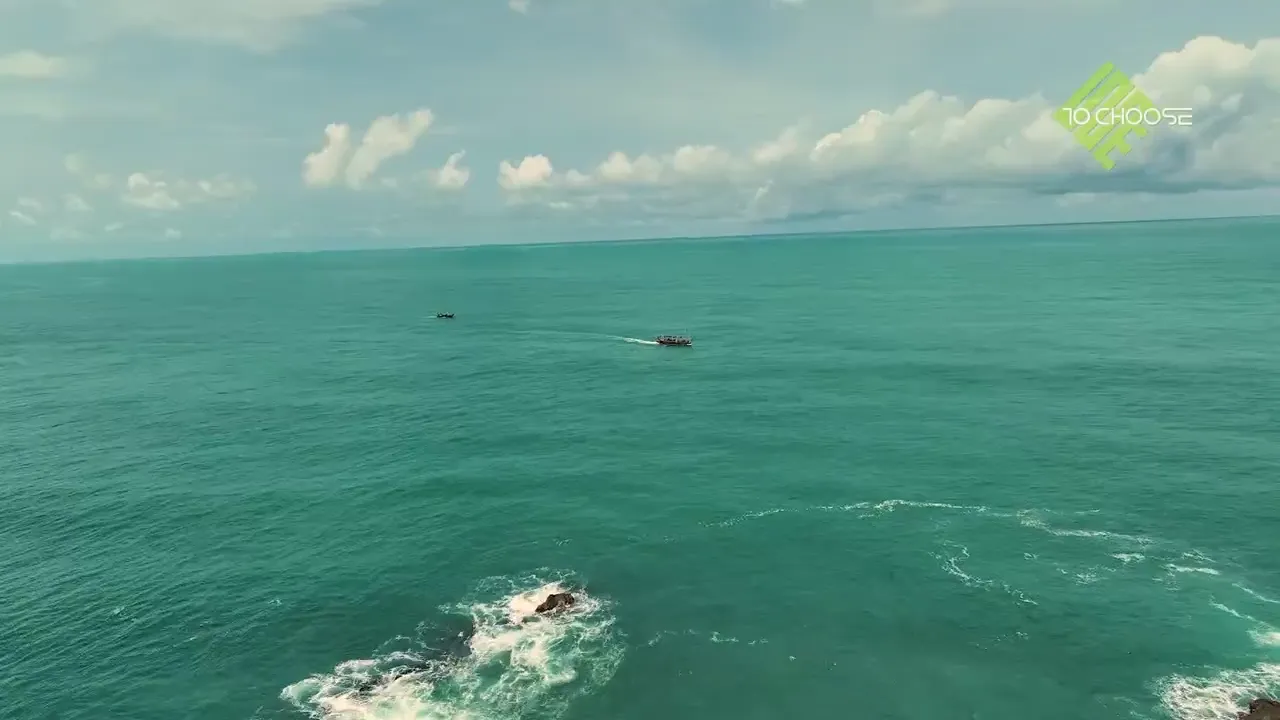
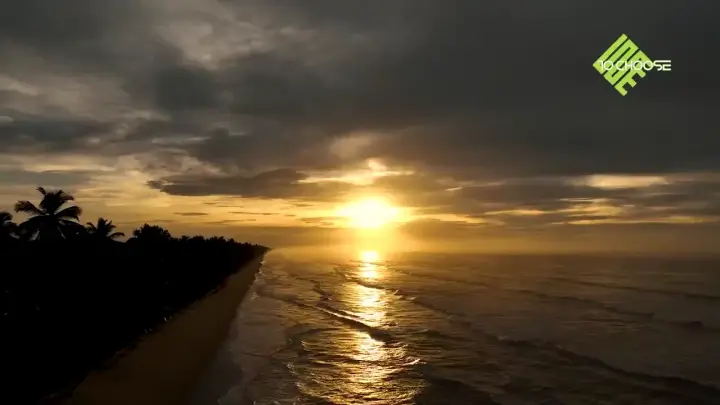
Every second breath you take comes from the sea. It covers most of our planet, it carries the heat we produce, and it feeds the coast where Kobina grew up. This is where the dive begins: in clear water, above the fishing boats of Ghana’s Western Region.
“It produces more than half of the world’s oxygen, it absorbs carbon dioxide and it regulates the climate.”
What you are looking at
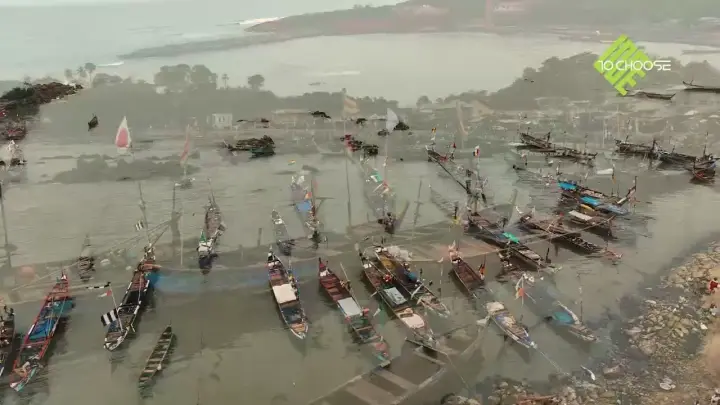
The sea off Takoradi feeds a nation. In Ghana fish is the most important animal protein, and most of it comes from wooden canoes like the ones in the film.
Facts
more than70 %The ocean covers more than 70 % of the Earth and produces more than half of its oxygen.NOAA ↗
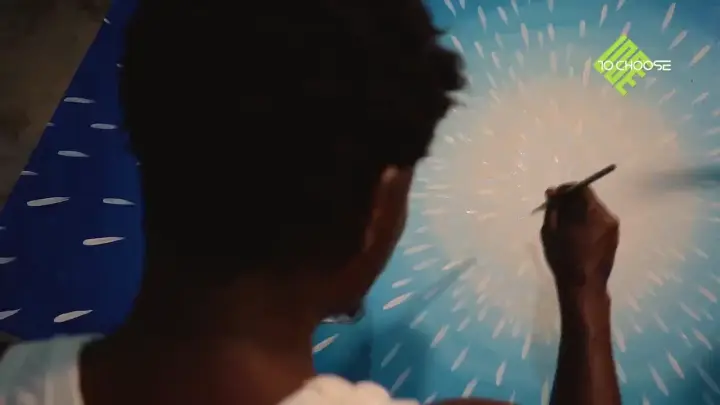
Kobina paints every fish as a single stroke. Thousands of strokes turn into one movement, the way a shoal moves as one body. He paints from below, from the eye of a hunter, and that is why his shoals so often spiral towards a point of light.
Facts
119,000 tSardinella, the shoaling fish on the canvas, were once Ghana’s most important catch: round sardinella landings were 119,000 tonnes in 1992.The Conversation, 2024 ↗
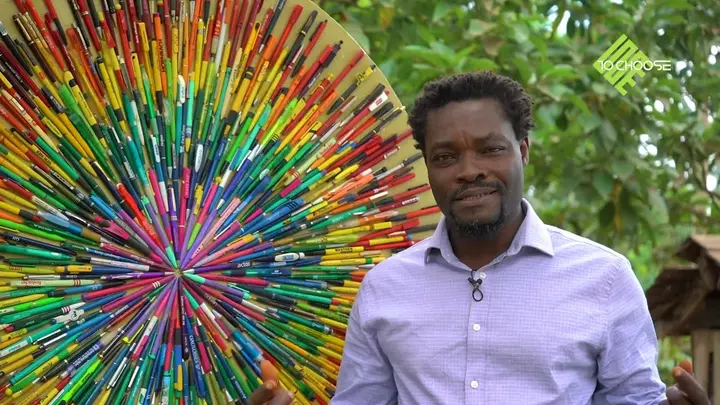
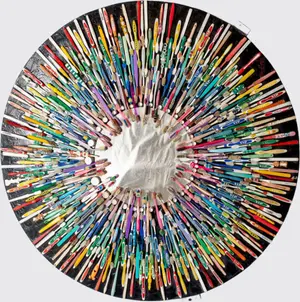
He started collecting to clean the beach. Then he saw the colours, and the plastic went into the paintings. From here on, it sinks with you. Tap the pieces to pull them out.
“I came to realize the beauty of the colors in it.”
What you are looking at
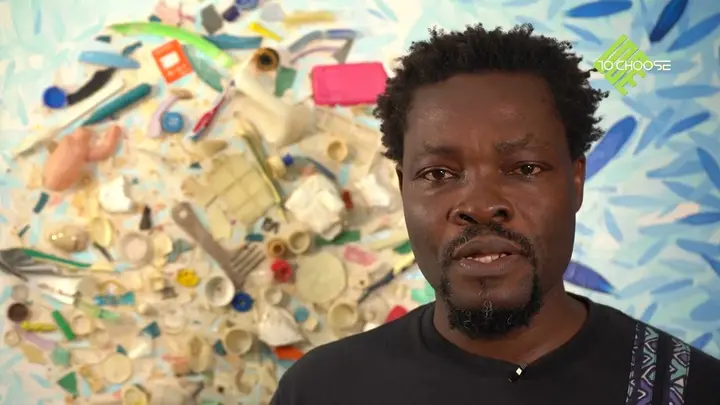
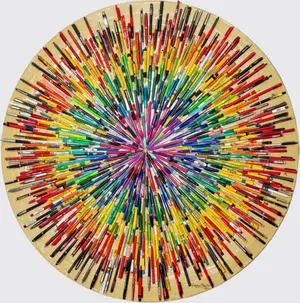
The colours in Kobina’s plastic works are not paint. They are the colours of the bottles, caps, toothbrushes and pens the sea brings back to Takoradi. He does not paint over them.
Facts
460 MtThe world made 460 million tonnes of plastic in 2019, twice as much as in 2000. Only 9 % was recycled.OECD Global Plastics Outlook 2022 ↗
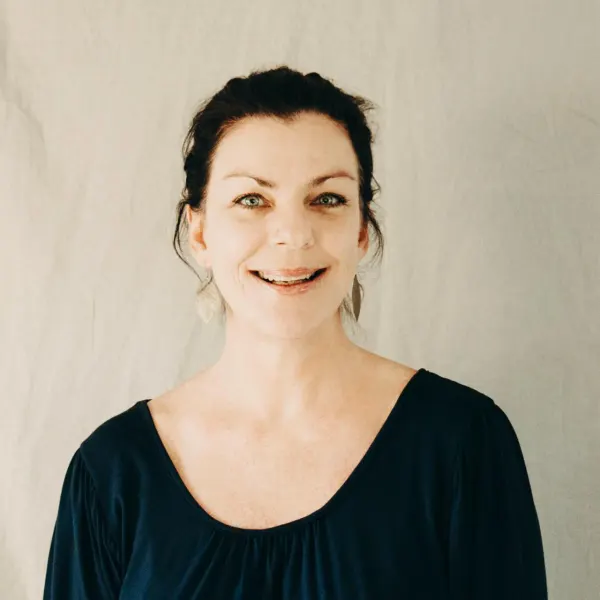
As a child in Plettenberg Bay, Michelle Beattie collected small coloured beads on the beach and called them mermaids’ tears. Years later she learned they were nurdles, the raw pellets of the plastic industry. Since 2020 she has made sculptures from plastic she finds on the beaches of Kommetjie and Scarborough near Cape Town. She does not melt or reshape it. The pieces keep the colours and forms the sea gave them.
Nurdles are the lentil-sized pellets almost every plastic product is made from. They are lost at every step between factory and ship, and the sea carries them to every coast, including the one where Michelle grew up.
Facts
under5 mmNurdles are usually smaller than 5 mm and are also known as “mermaid’s tears”.Marine Conservation Society ↗
1,680 tIn 2021 the X-Press Pearl caught fire off Sri Lanka with about 1,680 tonnes of pellets on board, described by a UN mission as the largest plastic spill on record.The Morning, Sri Lanka ↗
Emmanuel Aggrey Tieku paints on discarded second-hand clothing, the clothes the Global North throws away. Songs of Summer is one of these works. In How to Heal a Broken World he sews the clothes into one growing ribbon that travels to castles and museums in Europe.
“I’ve been using the reds, orange, and yellow to make that artistic statement.”
What you are looking at
Kobina’s blues turn red when he paints the warming sea. Off Ghana the change is no longer a forecast: marine heatwaves come more often, the sea rises and the coast is washing away.
Facts
more than90 %The ocean has absorbed more than 90 % of the extra heat trapped by greenhouse gases.UNESCO State of the Ocean 2024 ↗
When the canoes come in, the women take over. They smoke, sell and finance the fish. Their queen, the konkohemaa, sets the price on the beach. When catches shrink, they are the first to feel it.
Facts
about500,000About 500,000 Ghanaians work in processing and trading fish, most of them women.EJF via ADF, 2021 ↗
konkohemaaThe konkohemaa, or queen fishmonger, is chosen by the community, bargains with fishermen and speaks for the women.EcoWatch, Ghana’s queen fishmongers ↗
70 %In a study in Gomoa West, 70 % of women fish processors and traders were vulnerable on several measures at once.Appiah et al. 2021 ↗
“I found a shop which was selling a forbidden net, and I purchased from there.”
The mesh is so fine that nothing escapes it, not even the young fish. Kobina found it washed ashore, followed it to the shop and worked it into a painting.
A net with a mesh this small takes every fish, including the young ones that should become the next shoal. Kobina did not find it at sea. He bought it in a shop.
97 %In 2026 sampling, 97 % of round sardinella in trawler landings were below the legal size.EJF 2026, via newsghana ↗
about100,000 tIn 2017 about 100,000 tonnes of fish reached Ghana’s markets through “saiko”, the illegal transfer of trawler catch to canoes, worth tens of millions of dollars.EJF & Hen Mpoano, Stolen at Sea, via Dialogue Earth ↗
Kobina paints the plastic you can see. But the water off his coast carries something you cannot see. Inland, in the gold belt around Tarkwa and Obuasi, thousands of illegal mines, called galamsey, dig up the riverbeds. To bind the gold, the miners use mercury.
14,000NTU river turbidity, 2024
The rivers Pra and Ankobra carry the mud down to the coast. In 2024 Ghana Water measured river turbidity of 14,000 NTU; its plants are built for 2,000.
Small-scale gold mining causes almost 38 % of all human-made mercury emissions to air, more than any other sector. In the Ankobra estuary, mercury in sediment and fish exceeds ecological risk limits.
Protecting the sea means protecting the rivers that feed it.
In April 2026 Ghana declared its first marine protected area at Cape Three Points, between the two river mouths. Activists warn it cannot work while the rivers stay poisoned. As one put it, that would be like “locking the front door while leaving every window open”.
What you are looking at
Ghana’s gold lies inland, but its waste ends up in the sea. Illegal mining turns rivers brown and uses mercury, and the rivers Pra, Ankobra, Offin and Birim carry both to the Gulf of Guinea, right where Kobina paints.
almost38 %Small-scale gold mining causes almost 38 % of all human-made mercury emissions to air, more than any other sector.UNEP Global Mercury Assessment 2018 ↗
above the limitsIn the Ankobra estuary, mercury in sediment and fish exceeds ecological risk limits.Adebote et al., PLOS ONE 2025 ↗
3 to11 MtAn estimated 3 to 11 million tonnes of plastic lie on the ocean floor.CSIRO 2024 ↗
1,000 m
Down here, no light arrives
Move your light.
And yet
Ascent · Scene 6 of 9 · Hope and recovery
“My art piece, Rainbow in the Atlantic Ocean, symbolizes hope.”
Kobina Nyarko
Plastic pieces rise and form the work Rainbow in the Atlantic Ocean.
Waste with a value
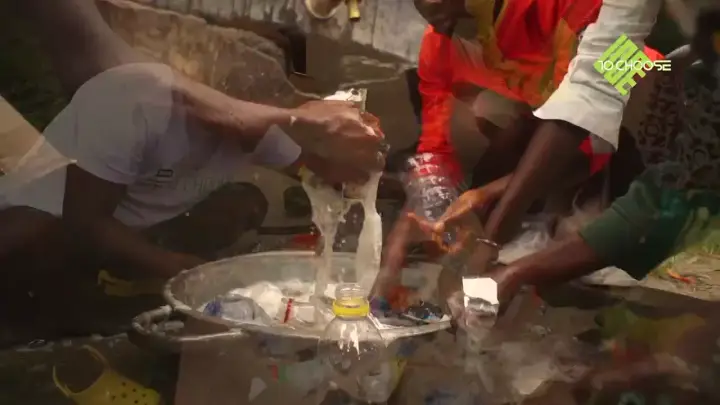
Kobina washes, sorts and cuts the plastic by colour and uses it like paint. Around his studio people now collect plastic because he buys it from them. What was rubbish has become an income, and the beaches get cleaner.
Kobina pays people in his community for the plastic they collect. Waste gets a price, and a beach gets cleaner. The rainbow is made of that plastic, 30 kilos of it.
“Let’s overcome the nothing can be done mentality.”
What you are looking at
Things are moving. Ghana now protects its first stretch of sea, and the high seas finally have a treaty.
Facts
about703 km²On 14 April 2026 Ghana declared its first Marine Protected Area at Greater Cape Three Points: about 703 km², co-managed with 21 communities, a spawning ground for sardinella, anchovy and mackerel.Mongabay, April 2026 ↗ · GhanaWeb, 15 April 2026 ↗
about10 %The world agreed to protect 30 % of the sea by 2030; about 10 % is protected today, 1.66 % of the high seas.UNEP via Down To Earth, April 2026 ↗
670 %In fully protected reserves fish biomass is on average 670 % higher.Sala & Giakoumi 2018 ↗
Source of Triplets, 2014Kobina NyarkoAcrylic on canvas100 × 140 cm
Sunny Day in the Sea, 2018Kobina NyarkoAcrylic on egg shell card58 × 70 cm
The plastic
Discovered Species, 2018Kobina NyarkoAcrylic on canvas91 × 162 cm
Forbidden, 2016Kobina NyarkoAcrylic and fishing net on canvas81 × 114 cm
Untitled (142 x 213), 2018Kobina NyarkoAcrylic on canvas142 × 213 cm
Red alert
Birth of Holes, 2019Kobina NyarkoAcrylic on canvas80 × 80 cm
Quenchless Source, 2021Kobina NyarkoAcrylic on canvas92 × 163 cm
Grey water
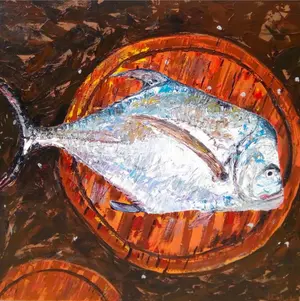
Monger’s Tray, 2018Kobina NyarkoAcrylic on canvas142 × 142 cm
Seasonal Catch, 2018Kobina NyarkoAcrylic on canvas97 × 97 cm
Breaking Freedom, 2018Kobina NyarkoAcrylic on canvas100 × 100 cm
The light returns
To the Agreed Location, 2019Kobina NyarkoAcrylic on canvas80 × 80 cm
Warm Passage, 2020Kobina NyarkoAcrylic on canvas152 × 100 cm
Circus in the Sea, 2015Kobina NyarkoAcrylic on canvas142 × 107 cm
Rainbow in the Atlantic OceanKobina NyarkoPlastic collected from the shore on canvas142 × 279 cm, 30 kg
Clear water
What travels with it
One world, five ways in
On Sylt in 2024 Kobina’s paintings went into three schools, and children worked with his motifs and with beach plastic. Dive with Kobina takes that further.
16
Framed works
The dive as a walk: blue water, the plastic, the red alert, the darkness and the rainbow at the end.
9
Film scenes
Feeling the Ocean’s Voice, shot in Takoradi, as a cinema corner. Each scene belongs to a part of the room.
1
School workshop
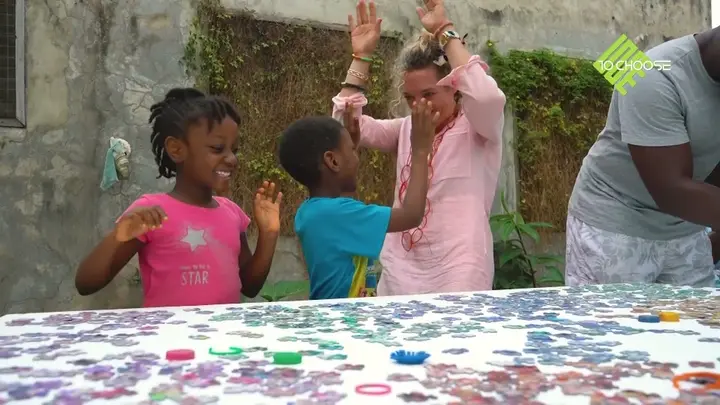
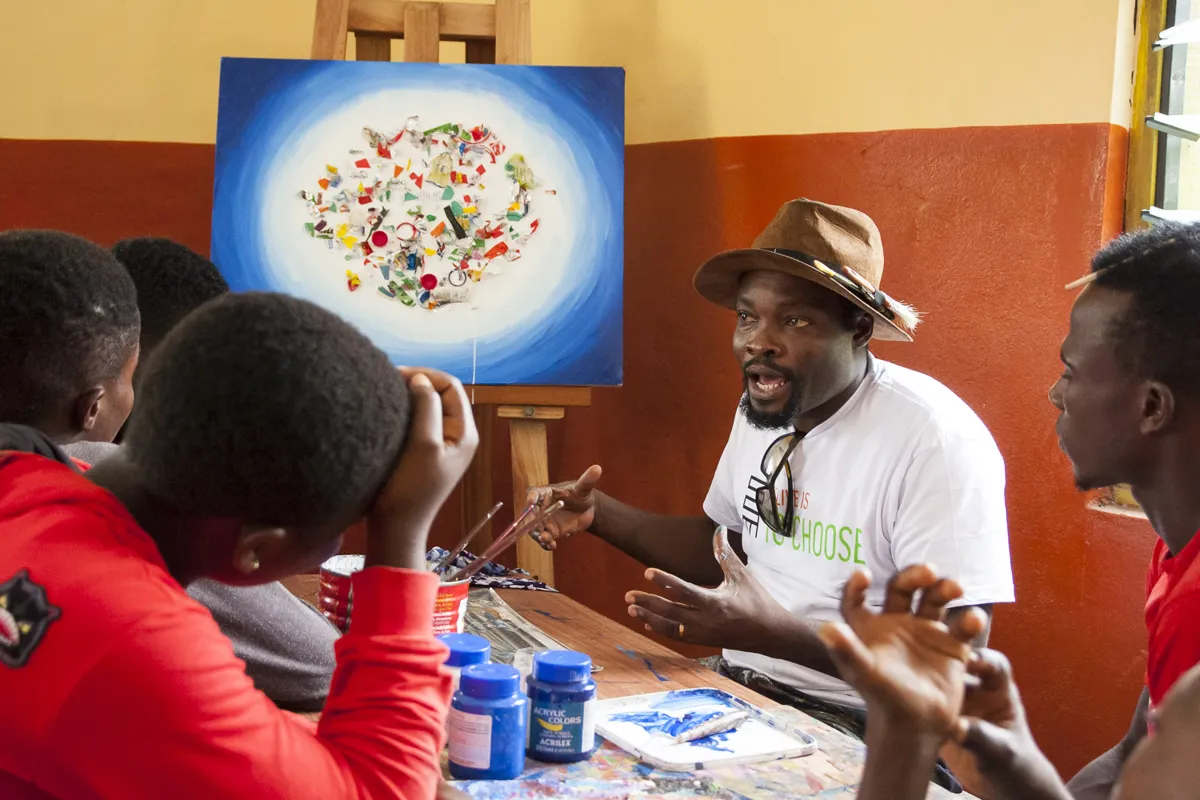
Classes make their own shoal from cleaned beach plastic, the way Kobina does. As on Sylt, the works go into the schools too.
1
Beach or river clean up
Visitors collect, sort and bring their finds back to a collection wall in the exhibition.
1
Talk about the rivers
Gold, mercury and the sea: an evening with scientists and ocean people on what reaches the coast and what can stop it.
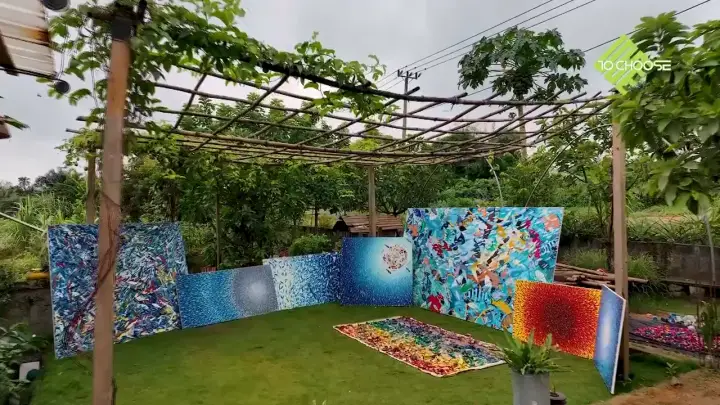
Kobina’s paintings in an open air garden exhibition.
What schools and hosts get
Workshops, as on Sylt
The film
The fact cards as prints
For people who love the sea
Aquariums and ocean museums
Islands and coastal towns
Dive and sailing clubs
Ocean foundations
Schools and universities
Companies that work with water
Hotels by the sea
Bring the ocean to your town
Host Dive with Kobina: sixteen works, the film, the workshops and the questions they raise.
Dive with Kobina is the touring exhibition of this page. The Living Web brings the three artists together.
Dive with Kobina
Ocean
Touring exhibition, 16 framed works
Kobina Nyarko’s fish shoals and the plastic that now swims with them, with our film “Feeling the Ocean’s Voice” and school workshops. Works by Michelle “Mishvania” Beattie and Emmanuel Aggrey Tieku join them.
For museums, companies with sustainability goals, schools and universities, public venues
The Living Web
Ocean
Threads of land, sea and self
Textiles, beach plastic and ocean paintings by Emmanuel Aggrey Tieku, Michelle “Mishvania” Beattie and Kobina Nyarko. The exhibition follows how small everyday choices travel through land and sea.
For galleries, museums, educational institutions, organisations working on the environment
Bring this theme to your place
Most projects start with a conversation. Tell us about the space and the people you want to reach.
Walk along any beach between Axim and Keta at dawn and you will see them: long wooden canoes, painted in bright colours, pushed into the surf by a dozen men at once. Ghana’s fishing fleet is not made of steel. It is made of wood.
Discovered Species
In 2016 Ghana’s Fisheries Commission counted 11,583 marine canoes at 292 landing beaches, crewed by more than 107,000 fishermen. By 2023 more than 12,275 canoes were registered, while experts recommend no more than 9,000 to 9,800 for the fish to recover.
These canoes land about 80 percent of the fish Ghanaians eat. And Ghanaians eat a lot of fish: about 23 kilos per person each year, against a world average of 16. Fish provides around 60 percent of the animal protein in the country. Between 2.5 and 3 million people, about one in ten Ghanaians, depend on the sea for their living, from the men in the canoes to the women who smoke and sell the catch.
Takoradi, where Kobina Nyarko grew up and still paints, is one of these fishing towns. When he paints a shoal, he paints the food of his neighbours.
The fish in Kobina’s shoals are often sardinella, small silver fish that move in huge groups close to the coast. For generations they were the backbone of Ghana’s canoe fishery.
Shoal Shower
In 1992 canoes landed 119,000 tonnes of round sardinella. In 2019 they landed 11,834 tonnes, a fall of about 90 percent. Over the same period the total catch of small pelagic fish fell by 59 percent, although more boats went out than ever before. A stock assessment covering 1990 to 2017 found anchovy, both sardinella species and bonga shad overfished, and judged all five stocks it studied to be at high risk of collapse.
For the people on the coast this is not a statistic. In a 2026 survey by the Environmental Justice Foundation, 94 percent of artisanal fishers said their catches were falling and 87 percent said their income was falling. Earlier research found that income per canoe had dropped by as much as 40 percent in 10 to 15 years.
This is why the shoal on this page spells out a sentence and then falls apart.
The world made 460 million tonnes of plastic in 2019, twice as much as in 2000. Only 9 percent was recycled. By then 109 million tonnes had built up in rivers and 30 million tonnes in the ocean, according to the OECD.
Beyond WasteEqual Time
Ghana produces about 1.1 million tonnes of plastic waste a year, and about 5 percent is collected for recycling. On two beaches near Accra, researchers found that plastic made up almost three quarters of all litter items. What the sea carries away, it brings back: to the beaches, and into the fish. Off Ghana’s coast microplastics were found in 41 percent of the sardinella sampled. Worldwide, more than 220 species have been found eating microplastic, more than half of them species we eat.
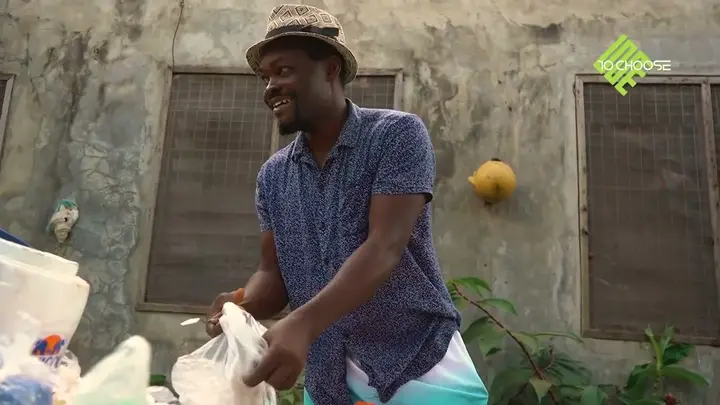
Kobina started by cleaning his beach. Then he saw the colours. Today people in his community collect plastic because he pays for it, and the bottles, caps, toothbrushes and pens end up in pictures like Beyond Waste and Equal Time, in the colours they came out of the sea.
On 10 October 2017 a storm hit Durban harbour. Two containers fell from the ship MSC Susanna and broke open. Inside were about 49 tonnes of plastic pellets, some two billion nurdles.
Coral BloomsOh I See
Nurdles are the raw material of the plastics industry: lentil-sized beads, usually smaller than 5 mm, melted down to make almost everything plastic. On beaches they look like fish eggs or tiny pearls, which is why people call them mermaid’s tears.
The Durban pellets did not stay in Durban. Within eight weeks the currents had carried them along more than 2,000 kilometres of South African coastline, as far as Gansbaai in the Western Cape, not far from the beaches where Michelle Beattie collects her material. Clean-up teams recovered about 36 tonnes; the work went on until 2020.
Durban was not an exception. In 2021 the X-Press Pearl caught fire off Sri Lanka with about 1,680 tonnes of pellets on board, called the largest plastic spill on record. In the EU alone, between 52,000 and 184,000 tonnes of pellets were lost in a single year. Since November 2025 an EU regulation obliges companies to stop these losses.
Michelle does not melt what she finds. She shows it as it is: “If I don’t show you, you will not see.”
The ocean has taken up more than 90 percent of the extra heat our greenhouse gases trap, and the rate of ocean warming has doubled in 20 years. Off West Africa, marine heatwaves have become more frequent along the northern Gulf of Guinea.
Red Shoal
Warm water expands, and ice melts. At Takoradi the sea is rising by about 3.3 millimetres every year. That sounds small. On a flat, sandy coast it is not. Ghana’s coastline retreats by about two metres a year on average, at some places by up to 17 metres in a single year.
East of Accra lies Keta. In the village of Fuveme, 37 percent of the land was lost to erosion and flooding between 2005 and 2017. Nearly 80 houses and a school were destroyed. In August 2024 tidal waves displaced 627 people in Dzita and Fuveme and destroyed 56 houses.
Kobina paints this sea in red, orange and yellow. It is the same sea, only warmer.
When the canoes come in, the men’s work ends and the women’s work begins. They buy the catch, smoke it, salt it, carry it to market and sell it. Many of them also finance the canoes and the fuel, and so secure their share of the next catch. About 500,000 Ghanaians work in processing and trading fish, most of them women.
Monger’s Tray
In every fishing community there is a konkohemaa, a queen fishmonger, chosen by the family heads. She bargains with the fishermen, settles disputes over prices and speaks for the women. Kobina’s Monger’s Tray shows what she sells: one fish, silver, on a wooden tray.
When the shoals shrink, the women feel it first. In one study in Gomoa West, 70 percent of women fish processors and traders were vulnerable on several measures at once. Research in Elmina describes how scarcity pushes some women into fish-for-sex: sexual relationships with fishermen to secure fish to sell. In a 2025 study, 63 percent of the 385 fishers interviewed in Elmina said that single motherhood linked to these relationships occurs in their community.
Empty nets are not only an environmental problem. They change who has power on the beach.
For years a strange trade took place off Ghana’s coast. Industrial trawlers, not allowed to sell to the local market, caught huge amounts of small fish they were not supposed to target. At sea they transferred this catch, frozen in blocks, to large canoes. The canoes brought it to the beaches of Elmina and sold it. Ghanaians call it saiko.
Forbidden
In 2017 about 100,000 tonnes of fish reached the markets this way, worth tens of millions of dollars. One saiko canoe could carry about 450 times the catch of an ordinary canoe trip. Nearly all the sardinella found in saiko blocks were juveniles below the legal size: fish that should have become the next shoal. The Environmental Justice Foundation links about 90 percent of Ghana’s industrial trawlers to Chinese owners who operate through Ghanaian front companies.
Then things changed. In 2025 Ghana passed a new Fisheries and Aquaculture Act. It doubles the inshore zone closed to industrial vessels from 6 to 12 nautical miles, sets up an independent Fisheries Commission and requires electronic monitoring of industrial vessels. In early 2026 EJF reported that saiko at sea had virtually stopped. The problem has moved into the ports: bycatch still makes up more than half of trawler landings, and in 2026 sampling 97 percent of the round sardinella in those landings were undersized.
Kobina’s Forbidden is made with a net whose mesh lets nothing through. He bought it in a shop.
Ghana is one of the world’s great gold producers. Much of that gold is dug illegally, in rivers and forests, by small crews with pumps and excavators. Ghanaians call it galamsey.
Galamsey turns rivers brown. In 2024 Ghana Water reported river turbidity of 14,000 NTU, while its treatment plants are built for 2,000. The Kwanyako plant ran with major setbacks for months; water supply to Cape Coast and Elmina fell by 75 percent. Scientists estimate that about 60 percent of Ghana’s water bodies are polluted, mainly by illegal mining.
To bind the gold, miners use mercury. Worldwide, small scale gold mining causes almost 38 percent of all human made mercury emissions to the air, more than any other sector. In Ghana the rivers Pra, Ankobra, Offin, Birim and Tano carry the sediment, and the mercury, to the Gulf of Guinea. In the Ankobra estuary, researchers found mercury in sediment and fish above ecological risk limits.
Ghana is pushing back. In December 2025 the government revoked the rule that had allowed mining in forest reserves.
The fish Kobina paints swim where these rivers meet the sea.
On 14 April 2026 Ghana declared its first Marine Protected Area, at Greater Cape Three Points in the Western Region, not far from Takoradi. It covers about 703 square kilometres, has a core zone closed to fishing and is managed together with 21 communities. It protects a key spawning ground of sardinella, anchovy and mackerel: the fish in Kobina’s shoals.
Protection works. In fully protected reserves, fish biomass is on average 670 percent higher than outside. At Cabo Pulmo in Mexico, fish biomass rose by more than 460 percent within ten years after the community stopped fishing.
The high seas, the ocean beyond any country’s waters, finally have rules too. The High Seas Treaty came into force on 17 January 2026; by October 2026 it had 102 parties. It covers 95 percent of the ocean’s volume. The world has agreed to protect 30 percent of the sea by 2030. Today it is about 10 percent.
Nothing can be done? A lot is being done. It needs more of us.